
Most plumbing is diagnosed by inference — symptoms, pressure, what happens when you run one fixture and not another. Drains are one of the few places where you can simply look.
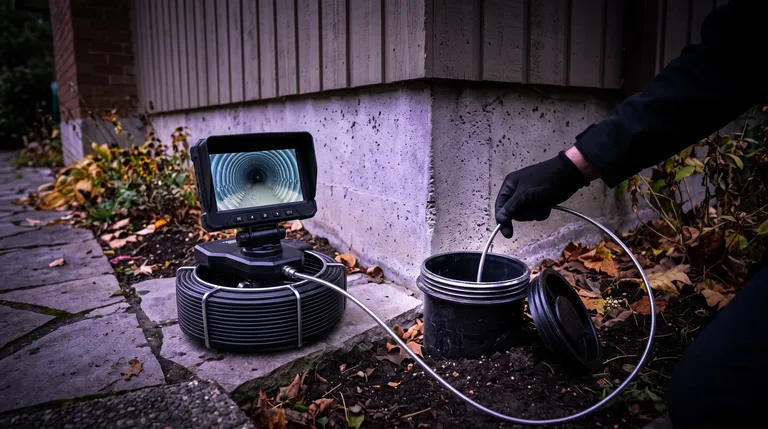
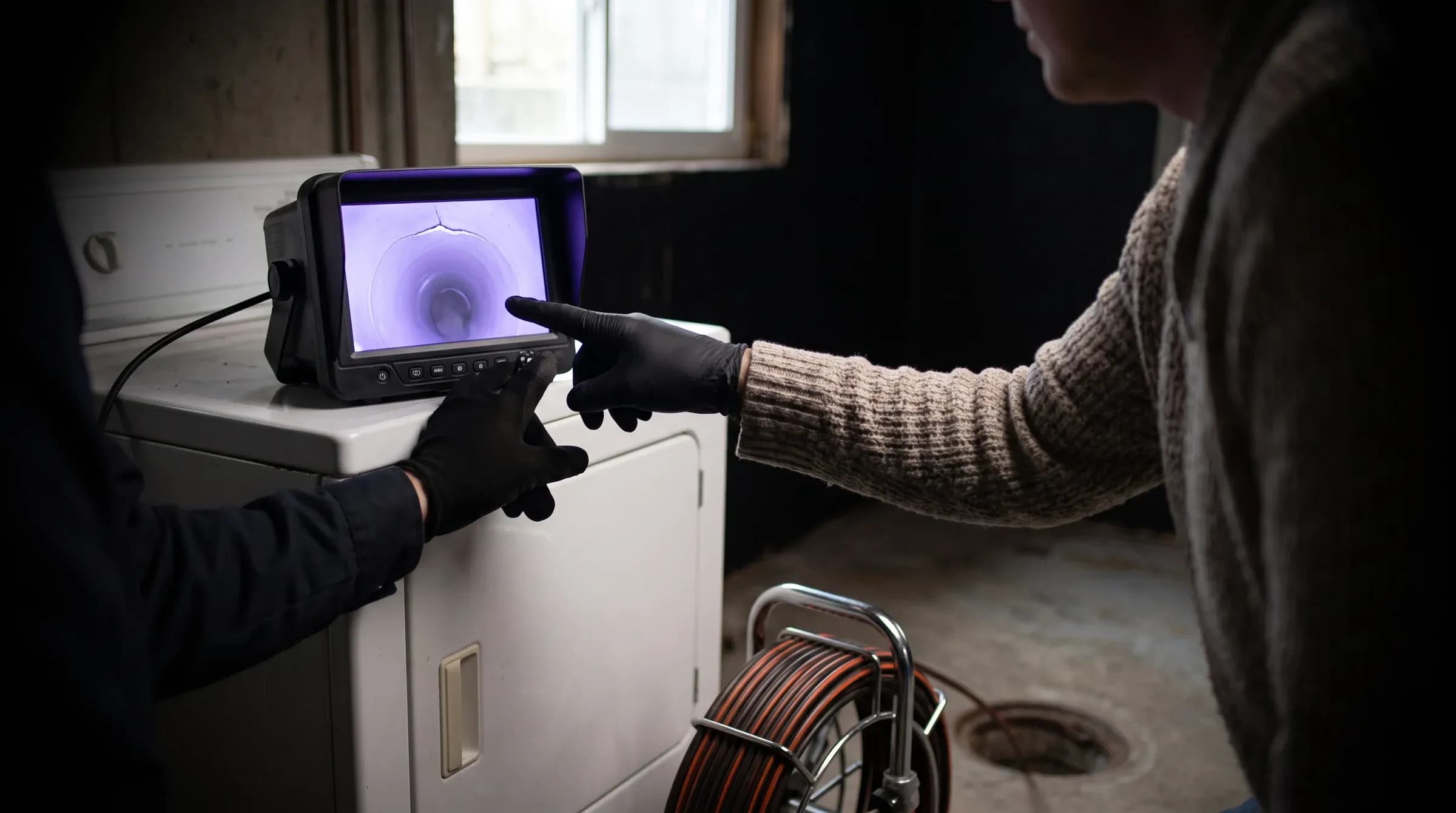
A camera on a flexible rod goes down the line and shows you the inside of the pipe on a screen, with a locator that identifies where the camera is under the ground. It is the difference between a theory and a picture.
What you can see
Roots. Fine roots entering at a joint or a crack, up to a full mass filling the pipe. Roots find water, and a drain line is a source of water and nutrients — they enter wherever there is a gap.
Cracks and breaks, from hairline fractures to sections that have fallen apart.
Offset joints, where two sections have shifted out of alignment. Offsets catch solids and are a common entry point for roots.
Bellies and sags, where the line has dropped and holds standing water. You see the water sitting in the low point, and that tells you why solids collect there.
Scale and grease, coating the wall and narrowing the effective diameter.
Collapsed sections, where the pipe has failed structurally.
Foreign objects, which are more common than you would expect.
Pipe material and condition — clay, cast iron, concrete, plastic — which tells you a great deal about what to expect. Older materials have known failure patterns and knowing what you have shapes the decision.
The locator matters as much as the camera
The camera head transmits a signal that can be picked up at the surface. So when something is found, its position can be marked on the ground and its depth estimated.
This is what turns a picture into a plan. Knowing there is a break somewhere in your sewer line is interesting. Knowing it is a specific distance from the house, at a specific depth, under the lawn rather than under the driveway, is what determines what the repair costs and how disruptive it is.
Ask for the location to be marked and recorded. It is the most valuable output of the inspection.
When it is worth doing
Before buying a property. It is the highest-value inspection most buyers do not do, and The sewer scope you should do before you buy explains why.
Recurring blockages, to find out why.
Before a decision about repair or replacement, so it is made on evidence rather than on the age of the house.
After a backup, to establish whether it was a one-off or a symptom.
Before landscaping or paving over a line, because what is easy to reach now will not be.
When buying an older home with mature trees near the line, which in much of Vancouver, Burnaby and New Westminster is most older homes.
What to ask while the camera is down there
Where is it, exactly, and how deep. What is the pipe made of. Is what you are seeing a maintenance problem or a structural one. Is the whole line like this or just this section. Can I have a copy of the footage.
That last one matters. Recorded footage is evidence — for a purchase negotiation, for an insurance conversation, for getting a second opinion, and as a baseline to compare against in five years. A camera inspection with no recording is worth much less than one with.
Cleaning first
A line full of debris shows you debris. If the pipe needs cleaning to be assessed properly, that usually happens first, then the camera goes down.
That sequencing is normal and worth expecting, so it does not feel like an upsell when it is proposed.
What it does not tell you
The camera shows the inside of the pipe. It does not show the soil around it, whether a break is actively leaking into the ground, or what is happening outside the pipe wall.
It also cannot always get all the way through — a severe blockage, a collapse or a tight offset can stop it. That in itself is information.
Vancouver, Burnaby, Richmond, Coquitlam, Port Coquitlam, New Westminster. 604-865-7979.
Related: Drain camera inspection · Sewer scope — before you buy · Sewer line repair and replacement