
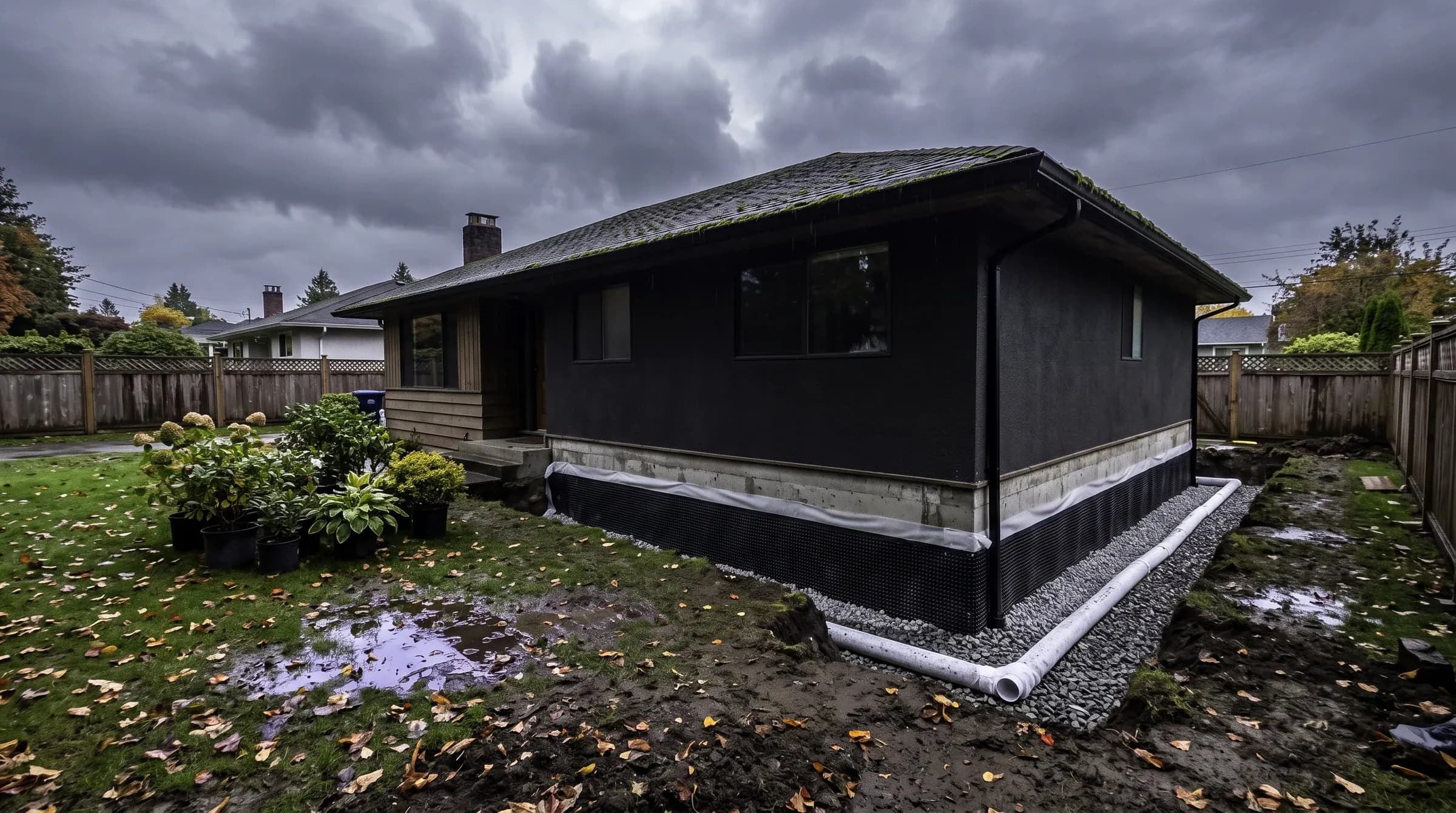
Perimeter drainage installation and replacement
Your perimeter drain — older tradespeople still call it weeping tile — is the pipe running around your foundation footings underground. Its job is to collect groundwater and carry it away before it can push against your basement walls.
In Vancouver, it does more work than almost anywhere in Canada. We get 1,150–1,700mm of rain a year, concentrated into the months when the ground is already saturated, and atmospheric rivers now deliver a month's worth in a few days. When the drain fails, the water has nowhere to go but into the foundation.
Full replacement typically runs $15,000–$25,000 for a detached home. Which one you need is what the camera decides — and we won't quote a replacement without showing you why.
Signs your perimeter drains are failing
Water in the basement, especially during or just after heavy rain — the clearest sign
Damp patches on basement walls, particularly low down near the floor
Efflorescence — white chalky deposits on concrete walls where water has moved through
A persistent musty smell in the basement that doesn't respond to ventilation
Pooling water against the foundation outside after rain
Soil settling or sinking along the foundation line
Cracks in the basement floor or lower walls
Sump pump running far more often than it used to — the water is arriving faster than it should
⚠️ One important thing: many failures show no symptoms until the failure is complete. A drain can be 80% blocked and you won't know until the winter it finally can't cope. That's why a camera inspection before the rainy season is worth more than waiting for a wet basement.
Why they fail here
Age and material. Homes built before the mid-1970s often have clay tile or unperforated pipe with no filter fabric. It silts up. Homes from the 70s–90s typically have perforated ABS or PVC, better but not permanent.
Silt and sediment. Fine soil migrates into the pipe over decades and settles in the low points. Without filter fabric, this is inevitable rather than unlucky.
Root intrusion. Vancouver's mature street trees and established gardens send roots toward the wettest thing available, which is a perimeter drain by design.
Crushing and settlement. Ground movement, heavy vehicles over a driveway, or backfill settling can flatten or offset sections.
Bad discharge. A drain that works perfectly but discharges next to the foundation, or into a storm connection that's itself blocked, achieves nothing.
Camera first. Always.
We won't quote a replacement without looking.
The inspection goes through the cleanouts where they exist, or we open access where they don't. You get the footage and a written report showing the actual condition, the location of any failures, and their depth. That report is also what your insurer will want if you're claiming for water ingress.
What replacement involves
This is excavation work. There's no version of it that isn't disruptive, and anyone telling you otherwise is misleading you.
Typical duration: 3–7 days for a full perimeter, weather depending.
1. Assessment and written quote. Camera inspection, then a fixed written price including the landscape reality. 2. Permit. Required in most Metro Vancouver municipalities. We pull it. 3. Excavation. We dig down to the footings around the affected perimeter. This means removing whatever is above — lawn, planting beds, patio, sometimes a section of driveway. 4. Remove the old system. Old pipe out, footing cleaned. 5. New drain installed. Perforated pipe on a clean gravel bed, wrapped in filter fabric — the fabric is what stops silt getting in and is the difference between a 15-year system and a 40-year one. 6. Foundation waterproofing. With the wall exposed, this is the only sensible moment to apply a damp-proof membrane. Doing it later means digging again. 7. Gravel and backfill, properly compacted in layers so it doesn't settle. 8. Discharge sorted. To a storm connection, a sump, or well clear of the foundation — whichever the municipality permits. 9. Inspection and test. Municipal inspection where required, then flow-tested. 10. Restoration, as set out in your written quote.
What it costs, and what moves it
What moves the number: access (a tight side yard between two houses is the expensive one) · depth of the footings · what's on top — lawn is cheap to remove, a stamped-concrete patio or mature landscaping is not · whether waterproofing is included · discharge — a new storm connection costs more than tying into an existing one · soil conditions and how wet the ground is when we dig.
⚠️ Comparing quotes? Check whether waterproofing, filter fabric, the permit, disposal and landscape restoration are each included.
- Partial replacement (one or two sides)
- $8,000–$15,000
- Full perimeter, standard lot
- $15,000–$25,000
Timing it
The best time to do this work is May through September — drier ground, faster excavation, better conditions for backfill compaction, and the system is ready before it's needed.
The worst time is during the storm that made you think about it. We do emergency drainage work, but it costs more, takes longer, and the restoration is harder in saturated ground.
If you're reading this in October with a damp basement: call us for the inspection now, and we'll tell you honestly whether it can wait until spring or whether it can't.
Where this matters most
Every part of our service area has drainage work, but some places are unavoidable. Richmond and Queensborough sit near sea level with a high water table. New Westminster's older neighbourhoods have the province's oldest housing stock and some of its oldest drainage. East Vancouver and Burnaby Heights combine pre-1960 homes with mature trees — the two ingredients for root intrusion. On the Westside, the issue is usually age plus extensive landscaping over the top.