
Boilers heat water and circulate it — through radiators, baseboards, or pipes in a floor — rather than blowing hot air around. It is a quieter, more even kind of heat, and well-maintained conventional boilers have a reputation for lasting a long time.
The ones that last are not luckier. They are the ones where somebody paid attention to the water.
The water in the system is the whole story
A hydronic heating system is a closed loop: the same water circulates continuously. Because it is closed, small problems compound rather than flushing away.
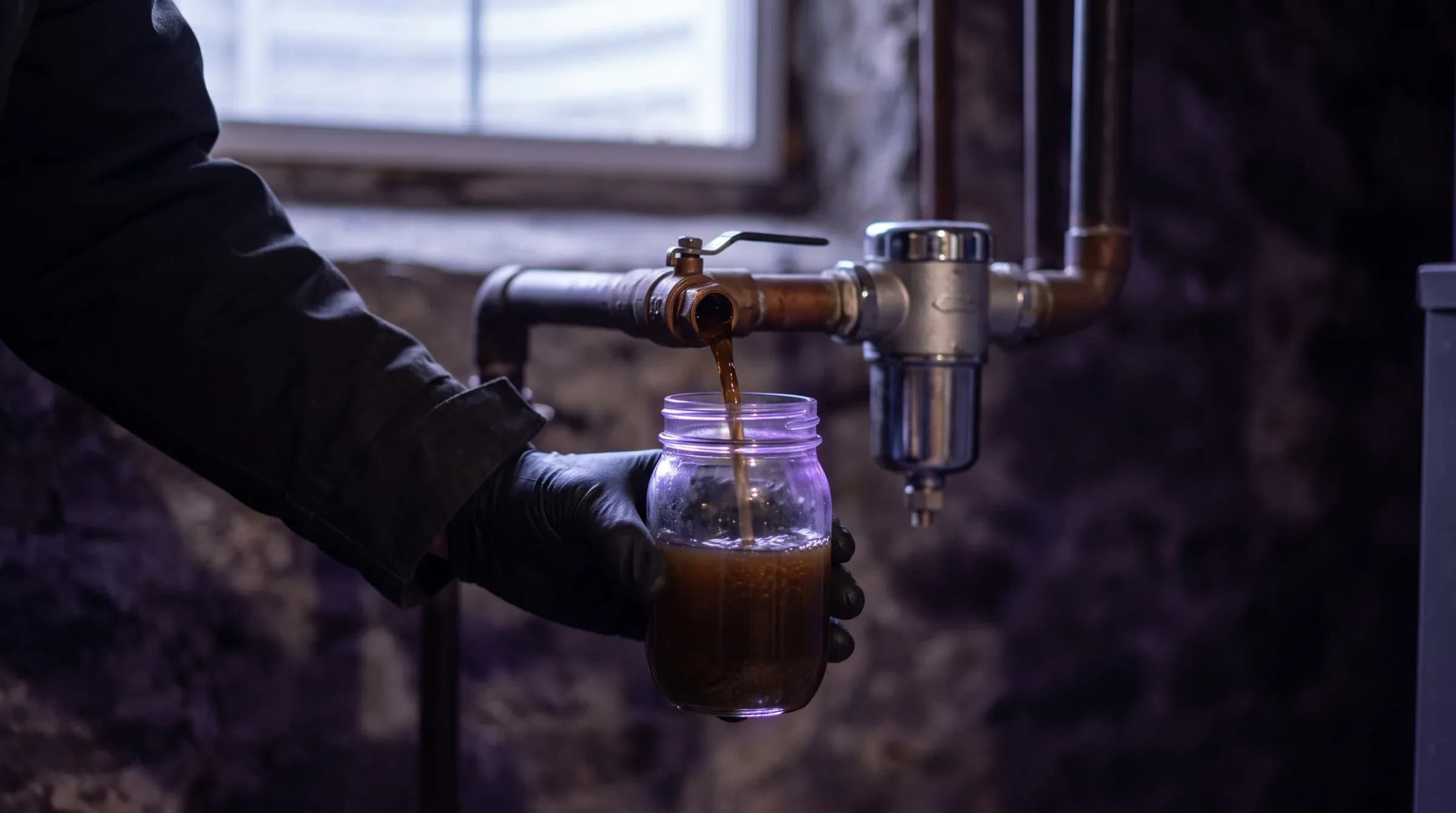
Sludge is the main one. Over years, corrosion inside radiators and pipework produces iron oxide that settles as black sludge. It collects in the bottom of radiators — which is why a radiator can be cold at the bottom and warm at the top — and it accumulates in the boiler and the pump. It reduces heat output, makes the pump work harder, and eventually blocks things.
Scale builds where the water is heated most, which is inside the boiler's own heat exchanger. Scale insulates, so the boiler has to work harder to deliver the same heat.
Air in the system produces gurgling, cold spots and radiators that will not heat. Air also accelerates corrosion, so it is not merely a comfort issue.
The countermeasures are unglamorous: correct inhibitor chemistry in the system water, bleeding air when it accumulates, and a power flush when sludge has built up enough to matter.
The signs your system is silting up
Radiators cold at the bottom, warm at the top. Some radiators never getting properly hot while others do. The boiler making more noise than it used to — kettling, a sound like a kettle boiling, is scale on the heat exchanger. Circulating pumps failing more than once. Water that comes out black when you bleed a radiator.
Any of those is worth investigating before the boiler is the thing that fails.
Pressure
Sealed systems run at a pressure, shown on a gauge on the boiler. It should sit in the normal band and stay there.
Pressure that keeps dropping means water is leaving the system. Somewhere — a radiator valve, a pipe joint, the pressure relief — water is escaping. Topping it up repeatedly is treating a symptom, and every top-up brings in fresh oxygenated water, which accelerates corrosion. So a system that needs frequent topping up is corroding faster than one that does not.
Pressure that climbs points at the expansion vessel or the filling loop, and it is worth looking at rather than ignoring.
Bleeding radiators
If a radiator is warm at the bottom and cold at the top, it has air in it. Bleeding is straightforward and most people can do it: turn the heating off, let it cool, open the bleed valve at the top of the radiator with the key, let air out until water appears, close it. Check system pressure afterwards and top up if needed.
If the same radiator needs bleeding repeatedly, air is getting in from somewhere and that is worth diagnosing.
Annual servicing
Same argument as any gas appliance, plus the water side: combustion and venting checked, safety controls tested, gas connections checked, and the system's pressure, inhibitor level and general condition assessed.
For a gas boiler the combustion safety half is not optional. For the water side, an annual look is what catches sludge before it becomes a power flush and a failed pump.
Repair or replace
Boilers are frequently worth repairing well past the point where a furnace would not be, because the heat exchanger is the expensive part and it can last a long time in a well-maintained system.
The arguments for replacement are the usual ones: parts unavailability, repeated failures, an exchanger that has failed, or a system so silted that the boiler is fighting the pipework. Efficiency is also a real consideration — an old boiler and a modern condensing one are not comparable in running cost.
If you are weighing it, the useful thing is an assessment of the whole system rather than just the boiler, because a new boiler on a sludged system will not perform and will not last.
Vancouver, Burnaby, Richmond, Coquitlam, Port Coquitlam, New Westminster. 604-865-7979.
Related: Boilers · Combi boilers · Radiant and in-floor heating