
A running toilet is the household fault people live with longest. It is not urgent, it is not visible, and there is usually another bathroom. So it runs.
The reason to deal with it is that it is one of the few faults that costs you continuously for as long as you ignore it.
What is actually happening
Two things fail, and it is almost always one of them.
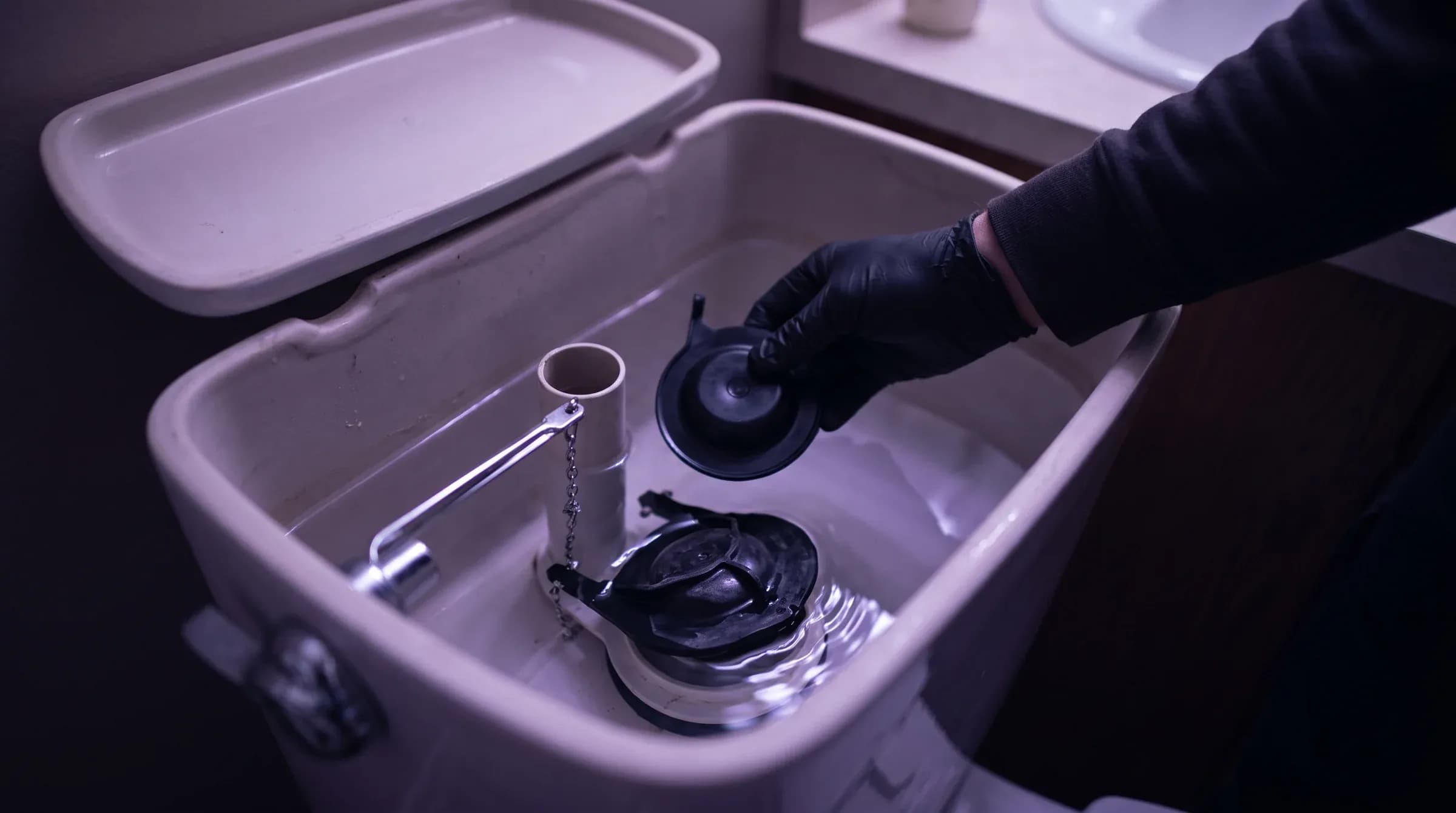
The flapper. At the bottom of the tank is a rubber seal that lifts when you flush and drops back to seal the tank. Rubber hardens and warps with age and with the chemistry of treated water. When it stops seating perfectly, water seeps past it into the bowl continuously, the tank level drops, and the fill valve tops it up — over and over.
This is the cause of the classic intermittent refill: the toilet has not been used, but every so often it runs for a few seconds. That is the tank refilling what leaked away.
The fill valve. The mechanism that refills the tank and shuts off at the right level. When it fails to shut off completely, water runs continuously into the overflow tube and down the drain. This is the version you can hear all the time.
The test
Put a few drops of food colouring in the tank. Do not flush. Wait, and look in the bowl.
If colour appears in the bowl, water is passing the flapper. That is the entire diagnosis and it costs nothing.
The silent version
The worst case is a toilet that leaks slowly enough that you never hear it refill. Water passes the flapper at a trickle and the fill valve keeps up without cycling audibly.
You find that one on your water bill, or with the food colouring test, or not at all. It is a good reason to do the dye test on every toilet in the house occasionally, particularly in a home with a bathroom that is rarely used.
Repair or replace
Most running toilets are a repair. Flappers and fill valves are consumable parts with a service life, and replacing them is routine work — genuinely the right answer for a sound toilet.
Replacement starts making more sense when: the tank or bowl is cracked, the toilet is leaking at the base repeatedly (which is a different problem — a wax ring or a flange issue, and one that puts water into your floor rather than down the drain), the toilet has needed repeated repairs, or it is old enough that its water consumption per flush is significantly above what a modern fixture uses.
That last one is the quiet argument for replacement in an older home. An old toilet uses considerably more water per flush than a current one, and in a busy household that difference accumulates every day, forever.
While someone is there
If a toilet is being worked on, that is the moment to check the supply valve behind it. Those valves seize with age, and the time you discover yours does not turn is the time the toilet is overflowing. Replacing a stiff supply valve during a scheduled visit is trivial; discovering it during an emergency is not.
The base leak, specifically
If water appears around the base of the toilet, treat that differently from a running toilet. That water is going into your floor, and floors under toilets are one of the more common places to find rot in a bathroom renovation. It is not urgent tonight, but it should not wait months.
We handle toilet repair and installation across Vancouver, Burnaby, Richmond, Coquitlam, Port Coquitlam and New Westminster. 604-865-7979.
Related: Toilet repair and installation · Fixture supply and installation · Plumbing maintenance and repair